|
| Book cover from Harlequin |
*Grades 9 and up
**2015 Lambda Literary Award Nominee
Sarah is entering her senior year of high school in 1959, which she'll be doing as one of only ten black students integrating into the formerly all-white Jefferson High School in Virginia. Linda is a white student at Jefferson, the daughter of the local newspaper editor, and she is extremely vocal about her anti-integration beliefs. When the two girls must work together on a school project, they realize that they work well together, as they also challenge the beliefs they have learned from their families. Sarah has feelings for Linda that make her uneasy, and they become closer even as they hide their friendship from their classmates and Linda’s father. They don’t understand their growing feelings but they know that the world they live in is unfair. The book is told through the alternating first person points of view of the two girls, and each chapter is titled with a new lie; for example, “Lie #1” (the first chapter) is titled “There’s no need to be afraid.” Truth vs. lies, loneliness, love, identity, and sexuality are all themes to which teenagers can relate. The issues of integration and segregation make this a great book to get a perspective on this period of American history, and human rights as they relate to race and homosexuality.
Partner Titles:
 |
| Book cover from Enslow Publishing |
Mayer, R.H. (2008). When the children marched: The Birmingham civil rights movement. Berkeley Heights, NJ: Enslow Publishing.
**2009 Carter G. Woodson Honor Book from the National Council for the Social Studies
This nonfiction book discusses children's role in the Civil Rights Movement. It makes a great partner title to study with Lies We Tell Ourselves because Sarah and her sister and friends are all high school students who are asked to be the first black students to integrate into their local white high school. Sarah sometimes feels like it isn't her cause, and that she doesn't want to be part of it. Her parents explain that someone must make sacrifices to change things and make life better for African Americans. When the Children Marched got an excellent review from Booklist: the review by Hazel Rochman says that the book has "many photos, news reports, and quotes from all sides" which "—will draw readers with their gripping drama" (2008). The book seems to be non-biased, and gives an often untold perspective of children in a troubling time in U.S. history. It is written to be accessible for students in grades 6-12, and can be used to build the historical framework for students.
Rochman, H. (2008, June 1). Review of the book When the children marched. Booklist, 104(19).
 |
| Book cover from LB Teen |
Alexie, S. (2007). The absolutely true diary of a part-time Indian. New York, NY: Little, Brown and Company.
**2007 National Book Award for Young People's Literature
**2008 Boston Globe Horn Book Award for Excellence in Children's Literature
**2008 American Indian Youth Literature Award from the American Indian Library Association
**2009 Odyssey Award from the American Library Association (for producer of the best audiobook for children and/or young adults)
Junior is a Spokane Indian who feels that the prospects for his future are narrow, and he doesn't want to be stuck on the reservation forever. He decides to go to a nearby white high school to get a better education, and he is suddenly treated differently. The white students see him as different and his fellow Indians in his town act like he is a bit of a traitor for going to school off-reservation. This book would be great to compare with Lies We Tell Ourselves because both Junior and Sarah are attending new schools and dealing with racist attitudes. Both novels include themes of belonging as the main characters bravely try to make their own places in an antagonistic world. This title would be great to listen to the audiobook, because it won the Odyssey Award, and this could be an excellent format to pair for high school students who read at a lower reading levels. It is definitely a story that will get teenagers' attention, because Junior has a strong and honest voice. The book does include cursing and discussions of sex, so it may not be appropriate for some younger teens.
 |
| Book cover from Simon & Schuster |
Hughes, L. & Smith, Jr., C.R. (Ill.). (2009). My people. New York, NY: Atheneum Books for Young People.
**2010 Coretta Scott King Illustrator Award from the American Library Association
While it is intended for young children, anyone can appreciate the beautiful photography in this book. The photos of African American individuals and families accompany Langston Hughes' poem, "My People," about the importance of family and heritage. Pairing this book with Lies We Tell Ourselves will help students to think about the themes of family and belonging in the novel.
 |
| Book cover from Top Shelf Productions |
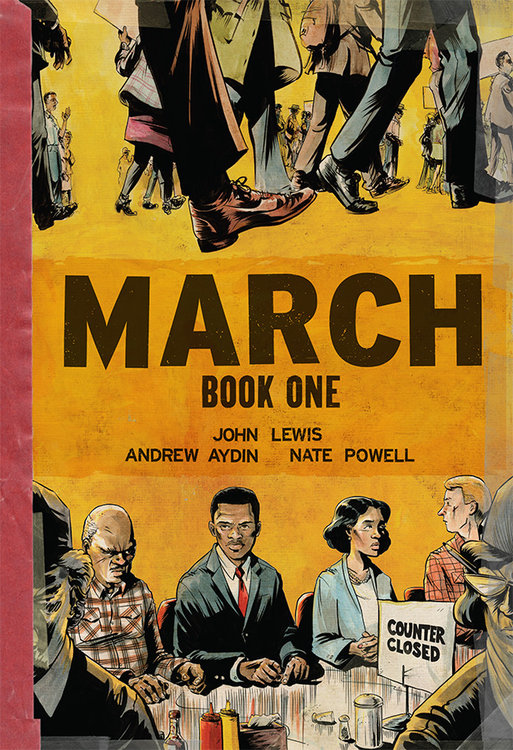
Lewis, J., Aydin, A., & Powell, N. (Ill.) (2013). March: Book one. Marietta, GA: Top Shelf Productions.
**2014 Coretta Scott King Author Honor from the American Library Association
John Lewis wrote this account of his experiences as a civil rights leader. According to the starred Horn Book review, "There’s something
extraordinary about reading a
firsthand account of a seminal moment
in history from one who not only lived
through it but also led it, and this is
what ultimately makes this book so
essential" (Bloom, 2014, p. 115). What makes it even more interesting to read for teens is that the memoir is in the form of a graphic novel. It shows some intense events in the Civil Rights Movement through illustrations, and is appropriate for middle and high school. The graphic memoir makes a great pair to Lies We Tell Ourselves because it is a retelling of true accounts from the time period. Students can assume that the characters in the novel would know all about the early events from Lewis' story from the news.
Bloom, S. (2014, Jan/Feb). Review of the book March: Book one. Horn Book Magazine, 90(1), 114-15.
 |
| Book cover from Penguin Random House |
**2013 NAIBA Young Adult Book of the Year
**2013 Lambda Literary Finalist
The main character has no body, but lives every day in a different body, inhabiting the life that body regularly leads. The main character is really neither male nor female, but falls for a girl when inhabiting the body of her boyfriend. This is a love that seems impossible. No one would expect such a person to exist at all. Every day would make a good partner book with Lies We Tell Ourselves because of the idea of forbidden love. Students could compare and contrast the ways that the world is keeping the two pairs of characters apart. Themes of truth and identity are also shared between the two books.
Teaching Ideas:
Point of View: The opposing points of view of Sarah and Linda are key to understanding the story. Ask students to find evidence to explain how Talley uses context and language to express both girls' perspectives. How does she make the reader sympathetic to both characters, but also make it clear which perspective she is more sympathetic to? Students can use their analysis to begin writing their own story with alternating, opposing, sympathetic points of view.
The English Standard of Learning 11.4 states that "The student will read, comprehend, and analyze relationships among American literature, history, and culture" and part e specifies for students to "Analyze how context and language structures convey an author's intent and viewpoint" (VDOE, 2010, p. 2).
Virginia and Integration: The novel is set in Virginia, and gives one a fictional account of racial integration in the state. Ask students to find true examples of how Virginia and its residents responded to court-ordered school integration. Is the novel accurate in its portrayal? Students could also find information about desegregation in other states, such as those farther south, and compare them.
The U.S. History Standard of Learning VUS.14 states that "The student will demonstrate knowledge of the Civil Rights movement of the 1950s and 1960s by a) identifying...how Virginia responded" (VDOE, 2008b, p. 14).
The Norfolk 17: Robin Talley's dedication of Lies We Tell Ourselves names the "Norfolk 17." Like Sarah and her friends, this was a group of students that integrated into a hostile environment. Students could compare the integration in the book with their research on this historical event. What was the role of the NAACP in the novel and with the Norfolk 17?
The U.S. History Standard of Learning VUS.14 states that "The student will demonstrate knowledge of the Civil Rights movement of the 1950s and 1960s by b) describing the importance of the National Association for the Advancement of Colored People (NAACP)" (VDOE, 2008b, p. 14).
Brown v. Board of Education: This landmark Supreme Court case was formed by combining cases from five different states. Students should familiarize themselves with the Brown v. Board cases, and reflect on how the ideas in these cases are portrayed in the novel. Sarah and Linda know all about this case and reference it in the book. How does it define part of who they are? After thinking about the importance of the case, students can write a personal reflection about how the decision made in 1954 has impacted our world today.
The U.S. History Standard of Learning VUS.14 states that "The student will demonstrate knowledge of the Civil Rights movement of the 1950s and 1960s by a) identifying the importance of the Brown v. Board of Education decision" (VDOE, 2008b, p. 14).
Civil Rights: Analyze primary source documents from the Civil Rights Movement with students. Discuss reactions as a class and how the documents tell us about history and about what being a citizen should mean. Read articles from the time period from different perspectives. Then ask students to locate current articles about civil rights issues. How are the issues and attitudes different today than they were in the 1950s and 1960s? How are they the same?
The Virginia and United States Government Standard of Learning GOVT.1 states that "The student will demonstrate mastery of the social studies skills responsible citizenship requires, including the ability to a) analyze primary and secondary source documents" (VDOE, 2008a, p. 1).
References:
Virginia Department of Education. (2010). Grade Eleven. English standards of learning for Virginia public schools. Retrieved from http://www.doe.virginia.gov/testing/sol/standards_docs/english/2010/stds_english11.pdf
Virginia Department of Education. (2008a). Virginia and United States government. History and Social Science Standards of Learning for Virginia Public Schools. Retrieved from http://www.doe.virginia.gov/testing/sol/standards_docs/history_socialscience/next_version/stds_va_usgov.pdf
Virginia Department of Education. (2008b). Virginia and United States history. History and Social Science Standards of Learning for Virginia Public Schools. Retrieved from http://www.doe.virginia.gov/testing/sol/standards_docs/history_socialscience/next_version/stds_va_ushistory.pdf
Robin Talley's Website, Twitter, and Facebook: Find out more about the author and follow her on social media. It is always interesting to find out more of an author's thoughts on her books, reading, and life in general.
Robin Talley's Lies We Tell Ourselves Blog Tags: These are the author's compiled blog posts referring to her novel. She wrote several posts about historic events that inspired her, which gives them special context for her readers.
Library of Congress Civil Rights Primary Source Sets: This resource contains groups of primary sources about the Jim Crow era and about the work of the NAACP. These include photographs, letters, flyers, speeches, and more, making them accessible to different types of learners.
Emmett Till: He is mentioned a couple of times throughout the novel, and this resource from History.com includes a short video and an overview of the tragedy of this young man's murder. It is a quick and easy to have the context to understand this historical reference in the book.
Library of Congress Brown v. Board Online Exhibition: This set of digital resources includes photos and documents with brief explanations of the historical context. This link goes to the first section, "A Century of Racial Segregation," and there are also two other sections, titled "Brown v. Board of Education" and "The Aftermath." These resources cover a broad time period related to segregation and the Civil Rights Movement.
Civil Rights Movement in Virginia: The Virginia Historical Society provides this excellent collection of photos with historical context explained simply. The link goes to the "Massive Resistance" section, discussing how Virginians reacted to desegregation, but all of the sections on the left navigation are worth exploring.
Washington Post article: This article about present-day Latino students and segregated schools is a fantastic resource to get students thinking about current violations of Brown v. Board of Education and how civil rights are still important to us today.
The White House Top Issues: Civil Rights: The U.S. government's White House website is all about the presidency. The Civil Rights page tells what the government is doing about present-day civil rights issues. Videos, articles, and timelines are included. Click the other tabs next to "Civil Rights Home" to see more related content.
References:
A&E Television Networks. (n.d.). The death of Emmett Till (August 28). This day in history. Retrieved from http://www.history.com/this-day-in-history/the-death-of-emmett-till
Brown v. Board at fifty: "With an even hand." (n.d.) Library of Congress. Retrieved from http://www.loc.gov/exhibits/brown/brown-segregation.html
Chandler, M.A. (2013, March 12). Latino students attending increasingly segregated schools in Virginia. The Washington Post. Retrieved from http://www.washingtonpost.com/local/education/latino-students-attending-increasingly-segregated-schools-in-virginia/2013/03/12/b34adef2-8b25-11e2-b63f-f53fb9f2fcb4_story.html
Civil rights. (n.d.). The White House. Retrieved from https://www.whitehouse.gov/issues/civil-rights
Civil rights: Primary source sets. (n.d.) Library of Congress. Retrieved from http://www.loc.gov/teachers/classroommaterials/themes/civil-rights/set.html
Civil rights movement in Virginia: Massive resistance. (n.d.) Virginia Historical Society. Retrieved from http://www.vahistorical.org/collections-and-resources/virginia-history-explorer/civil-rights-movement-virginia/massive
Talley, Robin. (2014). Tag archives: Lies we tell ourselves. Retrieved from http://www.robintalley.com/tag/lies-we-tell-ourselves/
Talley, Robin. (n.d.). Retrieved from http://www.robintalley.com/